Polity Notes
Surrogacy Regulation Act 2021
Surrogacy is a procedure in which a woman (Surrogate Mother) accepts to carry out a pregnancy in her womb to full term for a couple in which the wife cannot give birth to a baby naturally due to some medical complications. She (Surrogate Mother) pledges to abandon the child at birth, which is to be adopted by the woman who will become the biological and legal mother of the baby.
Concept of Surrogacy in Ancient Indian History -
The concept of assisted reproduction and practices resembling surrogacy can be found in ancient Indian mythology and epics, although these stories should be understood as mythological or symbolic references, not as evidence of modern medical surrogacy.
According to the Bhagavata Purana, the divine fetus of Balarama was transferred from the womb of Devaki to the womb of Rohini. This story is often compared with the modern idea of embryo or fetal transfer.
According to the Mahabharata, Karna was born to Kunti and Surya through divine invocation. Kunti abandoned him after birth, and he was raised by Adhiratha and Radha, reflecting an unconventional form of parenthood in ancient Indian mythology.
Niyoga was an ancient social practice through which a childless woman or a widow could have a child with a designated man, often a close relative of the deceased husband, to preserve the family lineage. In the Mahabharata, Satyavati requested Sage Vyasa to father children with the widows of King Vichitravirya, resulting in the birth of Dhritarashtra and Pandu.
Development of Surrogacy Law in India -
The technique of Surrogacy was a hope for childless couples to have their baby. India declared surrogacy legal in 2002. In due course of time, this technique was being misused by many women by offering themselves to work as surrogate mothers for financial gains. Married fertile women also started taking services of surrogate mothers to avoid the pains of pregnancy and also for their smooth running of career and business.
Surrogacy took the shape of a business and the technique started to be misused. Anand City in Gujarat became hub of surrogacy and Dr. Ms Nayna Patel became a Pioneer Medical expert in this field by producing more than 3000 babies through this new technology.
Surrogacy Regulation Bill 2019 was introduced by the then Union Health & Family Welfare Dr. Harsh Vardhan in Lok Sabha on 15th July, 2019. The bill defines surrogacy as a practice where a woman gives birth to a child for an intending couple with the intention to hand over the child after the birth to the intending couple.
The Bill prohibits Commercial Surrogacy but allows altruistic Surrogacy & widens the scope of applicability to include Indian married couples and Indian single women (only widows & divorcees between 35-45 years).
Altruistic Surrogacy refers to the surrogacy program where the surrogate mother doesn’t receive any financial compensation rather the intention should be to help the childless couple on humanitarian grounds.
Surrogacy will only be permitted when it is for intending couples who suffer from proven infertility.
It is mandatory for the couple to obtain a certificate of eligibility (proven infertility). Intending couples must not abandon the child born out of surrogacy under any condition. The new born child shall be entitled to all rights & privileges that are available to a natural child and no sex selection of the baby can be done in this process.
Mandatory registration for surrogacy clinic at appropriate authority.
The offence under the bill include advertising or undertaking for commercial surrogacy.
The bill was passed by Lok Sabha on 5th August, 2019 and was sent to a Select Committee of Rajya Sabha for review.
The Committee Submitted its report on 5th February, 2020 and gave 15 recommendations to be incorporated in new amended bill i.e. Surrogacy (Regulation Bill) 2020.
Major Provisions of the bill:
(1) The Bill Completely prohibits Commercial Surrogacy and allows only altruistic Surrogacy i.e. surrogate mother will not receive any financial compensation for her pregnancy except for medical and insurance expanses. Commercial surrogacy will be prohibited including the sale and purchase of human embryos & gametes.
(2) Allows surrogacy to Indian married heterosexual couples between 25-50 for wife & 26-55 for husband.
Selling or importing human embryos for surrogacy, exploiting the surrogating mother or the surrogate child and disowning the child has been made a Criminal offence.
The bill also proposes to regulate surrogacy by establishing a National Surrogacy Board and State Surrogacy Board whose function would be to advise the government on policy matters & supervise the funding of the clinics.
The Surrogacy (Regulation) Bill, 2019
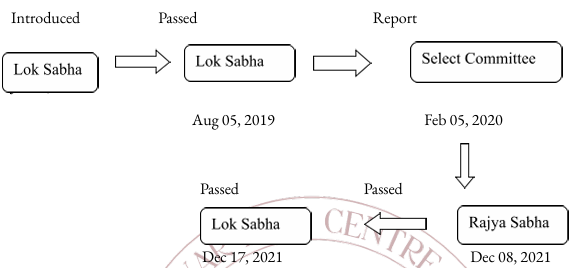
On 25 December, 2021 Bill gets President’s assent and becomes Act, coming into effect from 25th January 2022.
Surrogacy Regulation Act, 2021, The Act aims to prohibit commercial surrogacy and allows for altruistic surrogacy. In commercial surrogacy, the surrogate mother is compensated for her services beyond reimbursement for her medical expenses and insurance charges. Altruistic surrogacy means the surrogate mother will get only medical expenses and insurance coverage only.
Commercial surrogacy means commercialization of surrogacy services or buying or selling of human embryos or trading in the sale or purchase of human embryos or trading the services of surrogated motherhood by way of giving payment to the surrogate mother.
Legal position of surrogacy- The following surrogacies shall be legal-
a. Altruistic surrogacy
b. When it is not for producing children for sale or prostitution.
c. When it is not for commercial purposes.
d. when an intending couple has a medical indication necessitating gestational surrogacy provided that a couple of Indian origin or an intending woman who intends to avail surrogacy, shall obtain a certificate of recommendation from the Board.
Eligibility Conditions for Surrogate Mother and Intending Couple -
1. Eligibility Certificate of Surrogate Mother
Under Section 4(iii)(b), a surrogacy procedure can be undertaken only when the surrogate mother possesses an eligibility certificate issued by the Appropriate Authority.
2. Who Can Become a Surrogate Mother?
Only an ever-married woman who has a child of her own and is between 25 and 35 years of age on the day of implantation can become a surrogate mother.
3. Surrogate Mother Must Be a Close Relative and Willing
The surrogate mother must be a close relative of the intending couple and must voluntarily agree to act as a surrogate mother. She cannot be forced to undergo surrogacy. The intending couple or intending woman must approach the Appropriate Authority along with a woman who is willing to act as a surrogate mother.
4. Surrogate Mother Cannot Provide Her Own Gametes
A woman cannot act as a surrogate mother by providing her own gametes. In simple terms, the surrogate mother cannot contribute her own egg/oocyte to the embryo. This ensures that the surrogate mother is not the genetic mother of the child.
5. Surrogacy Only Once in Lifetime
A woman cannot act as a surrogate mother more than once in her lifetime. However, the Act leaves the number of attempts for surrogacy procedures to be prescribed by the rules.
6. Medical and Psychological Fitness
The surrogate mother must possess a certificate of medical and psychological fitness for surrogacy and surrogacy procedures. This certificate must be issued by a registered medical practitioner.
Eligibility of Intending Couple -
Under Section 4(iii)(c), the intending couple must separately obtain an eligibility certificate from the Appropriate Authority.
7. Age, Marriage and Minimum Marriage Duration
The intending couple must be legally married for at least 5 years. At the time of certification:
● Female partner: must be between 23 and 50 years
● Male partner: must be between 26 and 55 years
8. No Surviving Child
Having a surviving biological child, adopted child or child born through an earlier surrogacy ordinarily makes the couple ineligible.
9. Exception for a Child with Serious Medical Conditions
There is an important exception to the above rule. The couple can still be eligible if they already have a child who:
● is mentally or physically challenged, or
● suffers from a life-threatening disorder, or
● suffers from a fatal illness for which there is no permanent cure.
However, this exception is subject to approval by the Appropriate Authority and requires a due medical certificate from a District Medical Board.
10. Other Conditions
Apart from the conditions specifically mentioned above, the intending couple must also satisfy such other conditions as may be specified by the regulations.
Restriction on promoting commercial surrogacy -no surrogacy clinic, gynaecologist, registered medical practitioner or any person shall conduct, offer, undertake, promote or associate with commercial surrogacy in any form.
Prohibition of commercial surrogacy, exploitation of surrogate mothers and children born through surrogacy- Organization, surrogacy clinic, laboratory etc. undertake commercial surrogacy in any form or run a racket or select surrogate mothers.
Restriction on advertising commercial surrogacy - issue, publish, distribute, communicate, any advertisement in any manner regarding commercial surrogacy by any means.
No institution/surrogacy clinic can Abandon or exploit children born through surrogacy.
Ban on selling embryos for the purposes of surrogacy.
Prohibition of conducting sex selection in any form for surrogacy
Insurance cover- insurance cover for surrogate mother has now been increased to 36 months from 16 months provided in the earlier version.
Constitution of National Surrogacy Board- National Surrogacy Board shall be constituted to exercise the powers and perform the functions conferred on the Board under this Act.
Penal provisions under the Act- Section 41 of the Act provides for punishment which may extend to three years and a fine which may extend to Rs. five lakh in case of contravening the provisions of the Act for the first time and in case of continuing contravention with an additional fine which may extend to ten thousand rupees for every day during which such contravention continues after conviction for the first such contravention. Offences to be cognizable, non-bailable and non-compoundable under section 43 of the Act.
Objections to Surrogacy Regulation Act, 2021
IVF specialist moves Supreme Court challenging provisions of surrogacy Regulation Act 2021.
This Act excludes members of the LGBT community, single women who are neither widowed or divorced, single men, couples suffering from secondary infertility etc. from availing services and hence violates Article 14 of the Indian Constitution. Secondary Infertility means not being able to have another child after having successfully had a child before.
Another issue is that this Act violates the fundamental right of privacy under Article 21 of the Indian Constitution as they consist of a pre-condition of a genetically related surrogate mother for the purpose of surrogacy.
While referring to the ban on commercial surrogacy by the act as "unnecessary and undesirable", the petition states that "The ban on commercial surrogacy, seemingly enacted to protect the impoverished women, denudes surrogates of their right over their bodies and denies them the opportunity to exercise agency over their right of giving birth.”
2024 Amendment - Donor Gametes
The Surrogacy (Regulation) Amendment Rules, 2024, notified on 21 February 2024. The amendment relaxed the earlier restriction on donor gametes in limited medical circumstances. Where a District Medical Board certifies that one spouse requires a donor gamete, surrogacy can proceed using a donor gamete, but the child must have at least one gamete from the intending couple. This was an important shift from the earlier absolute restriction on donor gametes.
2025 Supreme Court Judgment - Vijaya Kumari S. v. Union of India
A major judicial development came in Vijaya Kumari S. v. Union of India, decided by the Supreme Court in October 2025. The issue concerned the statutory age limit of 50 years for the intending woman and 55 years for the intending man. The Court held that the age restriction under Section 4(iii)(c)(I) cannot operate retrospectively against couples who had already commenced the surrogacy process before the Act came into force on 25 January 2022, particularly where embryos had already been created and frozen. The Court linked the issue with the constitutional protection of reproductive autonomy under Article 21.