What is the Shanghai Cooperation Organisation?
The Shanghai Cooperation Organisation (SCO) is a Eurasian regional organisation established on 15 June 2001 in Shanghai, China by China, Russia, Kazakhstan, Kyrgyzstan, Tajikistan and Uzbekistan. It developed from the earlier “Shanghai Five” mechanism, which focused mainly on confidence-building and security along borders. Over time, the SCO expanded its agenda to include regional security, counter-terrorism, economic cooperation, connectivity, energy, technology and cultural exchanges.
SCO Membership -
At present, the SCO has 10 member states i.e. China, Russia, Kazakhstan, Kyrgyzstan, Tajikistan, Uzbekistan, India, Pakistan, Iran and Belarus.
India and Pakistan became full members in 2017, Iran joined in 2023, and Belarus became the latest full member in 2024. Afghanistan and Mongolia hold observer status, while the organisation also has 15 dialogue partners.
India and the SCO -
India became a full member of the SCO in 2017, along with Pakistan. India uses the organisation as a platform to engage with major Eurasian powers, particularly Russia, China and the Central Asian states. Its priorities within the SCO include counter-terrorism, regional connectivity, economic cooperation, energy security and respect for sovereignty and territorial integrity. India has also consistently opposed the use of terrorism for political purposes and emphasised the need to avoid “double standards” in combating terrorism.
2026 Bishkek SCO Summit -
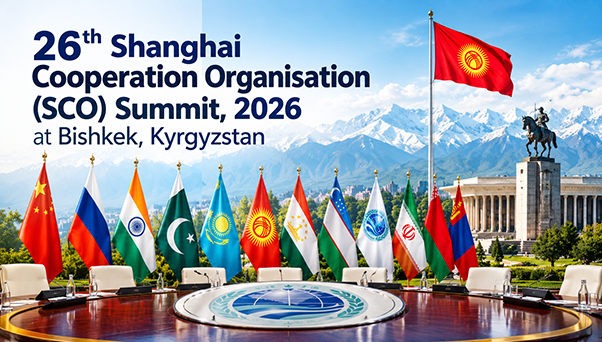
The 2026 Bishkek SCO Summit was the 26th meeting of the Council of Heads of State of the SCO. It was held in Bishkek, Kyrgyzstan, from 31 August to 1 September 2026. The summit was chaired by Kyrgyz President Sadyr Japarov and marked the 25th anniversary of the SCO. It was also the fourth time that Kyrgyzstan hosted the SCO Heads of State meeting.
Theme - The summit was held under the theme of “25 Years of the SCO: Together for Sustainable Peace, Development and Prosperity.”
The theme reflected the organisation’s attempt to move beyond traditional security concerns and strengthen cooperation in development, connectivity, energy, technology and regional stability.
Major Participants - The summit brought together the leaders of the SCO’s 10 member states, including India, China, Russia, Pakistan, Iran and Belarus. A wider SCO Plus format also brought together representatives from observer and partner countries and international organisations.
Major Outcomes - The summit adopted the Bishkek Declaration along with 27 other documents dealing with areas such as security, counter-narcotics, artificial intelligence, biodiversity, energy, climate cooperation, nuclear security and regional logistics. This showed the growing scope of the SCO beyond its original security-oriented role.
Security and Counter-Terrorism -
Counter-terrorism remained a major priority. The declaration reiterated the need to combat terrorism, separatism and extremism without applying double standards. For India, this is particularly important because it has repeatedly pushed for stronger international action against terrorism and the dismantling of terrorist networks.
Iran and West Asia -
The Bishkek Declaration strongly addressed the situation involving Iran, condemning military strikes on Iranian territory and supporting Iran’s sovereignty and its right to pursue a peaceful nuclear programme under the Nuclear Non-Proliferation Treaty (NPT). It called for a diplomatic solution to the conflict.
Economic and Energy Cooperation -
The summit also focused on trade, energy security, infrastructure and regional connectivity. Discussions during Kyrgyzstan’s chairmanship had included energy security and a proposed SCO Energy Consortium, reflecting the importance of energy cooperation among member states.
India at the Bishkek Summit -
India’s participation was important because the SCO provides New Delhi with a platform to engage simultaneously with Russia, China, Central Asia and other Eurasian countries. Prime Minister Narendra Modi participated in the summit, while India emphasised security, connectivity and economic opportunities. The summit also saw a brief interaction between PM Modi and Chinese President Xi Jinping, viewed as a diplomatic signal amid efforts to improve India-China relations after the tensions that followed the 2020 border clashes.
Change of SCO Chairmanship -
At the conclusion of the summit, Kyrgyzstan handed over the rotating SCO chairmanship to Pakistan. Pakistan will therefore oversee the organisation’s next cycle and is scheduled to host the 2027 SCO Summit in Islamabad. The 25th SCO summit was held in Tianjin, China in 2025.