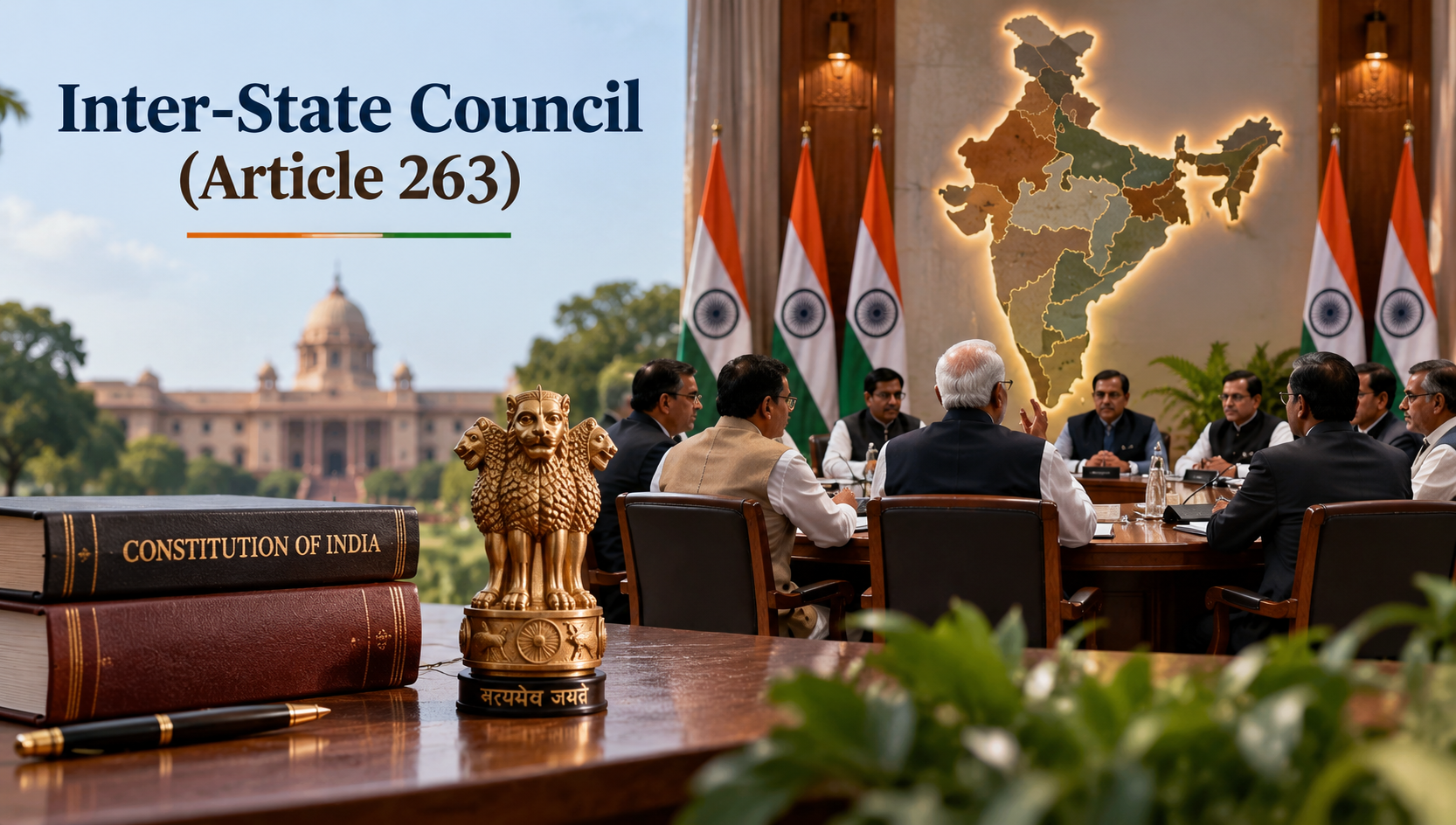
Inter-State Council (Article 263)
In India both the Union Government and State Governments exercise their powers within their respective spheres. For the overall development of the country, it is essential that the Centre and the States should work together as equal partners. Therefore, Indian federalism is expected to function on the principle of cooperative federalism. However, in practice, this ideal has often faced challenges. The Union Government has, at times, been accused of using its powers for narrow political gains, including attempts to destabilise or weaken opposition-ruled State Governments and providing them with unequal or discriminatory treatment.
In view of various problems between healthy relations between Centre and States, the Union Government set up a Commission in June 1983 under the Chairmanship of Justice R.S. Sarkaria (Known as Sarkaria Commission) to suggest reforms in distribution of Powers between Union and States and also to Suggest ways to improve relations between union and states to make our federal structure more effective towards development & progress of India. Sarkaria Commission submitted its report in 1988 and made several recommendations including the recommendation to establish an Inter-State Council.
The Union Government considered the report and accepted some of the recommendations of Sarkaria Commission and established the Inter State Council on 28th May, 1990 as recommended by this commission under Article 263 of the Constitution.
The Inter State Council is a Constitutional body as it is now mentioned in our Constitution. Though, it is not a permanent constitutional body and may be constituted by the President whenever public interest requires. Its functions include inquiring into and advising on disputes between States or between Union and States, discussing matters of common interest, and making recommendations to improve coordination of policies and actions between the Union and the States.
The Head-Quarter of Inter State Council is at New Delhi.
Inter-State Council was established to support Centre-State and Inter-State Coordination and Cooperation, to promote and support cooperative federalism in India, activate Zonal Councils by organising its regular meetings, facilitate Consideration of all pending issues and emerging issues of Centre State and Inter-State relations by Zonal Councils and Inter-State Council and to develop system of monitoring the implementation of the recommendation of the of Inter-State Council and Zonal Councils.
Composition of Inter-State Council
Chairman - Ex-officio (Prime Minister)
Members - Chief Ministers of all States and Representatives of UTs
Members - 6 Union Cabinet Ministers nominated by Prime Minister
Meetings of Inter - State Council -
The meetings of Inter-State Council were held from time to time to discuss and resolve matters between Center and State and among States to boost Development and welfare of the masses.
The Inter-State Council has held 11 meetings so far. Its first meeting was held on 10 October 1990, where key issues such as the Sarkaria Commission Report on Centre-State Relations, inter-State taxation, excise duties, and setting up special courts for economic and narcotics-related offences were discussed. The 11th and latest meeting was held on 16 July 2016, which considered the Punchhi Commission’s recommendations on Centre-State Relations, along with issues such as Aadhaar and DBT, improving school education, and internal security, including police reforms and intelligence sharing.
Significance of Inter-State Council -
● Constitutional Mandate: Article 263 provides a constitutional basis for Centre-State dialogue.
● Multilateral Forum: Facilitates discussion on issues like disaster management, terrorism and internal security.
● Strengthens Federalism: Promotes cooperation, coordination and trust between the Centre and States.
● Resolve Conflict: It provides a platform for discussion of inter-state and Centre and State disputes.
● Consensus Building: It helps develop coordinated solutions to issues of national importance.
Inter-State Council Limitations -
● Only Advisory Body: Its recommendations are non binding resulting in limited effectiveness.
● Irregular Meetings: Irregular meetings affect timely response to emerging issues. As the 11th (latest meeting) was held on 16 July 2016.
● Temporary in Nature: Council function depends on the Presidential constitution.
● Limited State Participation: Unequal engagement may prevent adequate representation of regional concerns.