India’s Medal Tally (2026 Commonwealth Games)
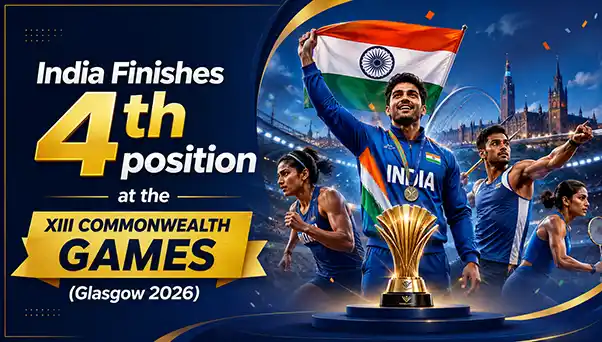
India finished 4th in the medal standings at the XXIII Commonwealth Games, Glasgow 2026, with a total of 39 medals comprising 13 Gold, 17 Silver, and 9 Bronze. Despite the exclusion of traditional medal-rich sports such as Wrestling, Badminton, Table Tennis, Hockey, and Shooting, India delivered an impressive performance.
Boxing emerged as India’s best sport with 10 medals, including a record seven gold medals. Mirabai Chanu won her third consecutive Commonwealth Games gold medal, while Asmita Dey became India’s first-ever Commonwealth Games champion in Judo. Gulveer Singh became the first Indian track and field athlete to win two individual medals at a single Commonwealth Games. Neeraj Chopra won silver medal in javelin Throw.
Top 5 Countries in the Medal Table (2026) -
| Rank | Country | Gold | Silver | Bronze | Total |
| 1 | Australia | 70 | 45 | 56 | 171 |
| 2 | England | 29 | 45 | 36 | 110 |
| 3 | Canada | 19 | 21 | 23 | 63 |
| 4 | India | 13 | 17 | 9 | 39 |
| 5 | Scotland (Host) | 13 | 9 | 17 | 39 |
XXIII Commonwealth Games (Glasgow, 2026) -
The 2026 Commonwealth Games, officially known as the XXIII Commonwealth Games, were held in Glasgow, Scotland (UK) from 23 July to 2 August 2026. It is an international quadrennial (after every Four year) multi-sport event involving athletes from 72 Commonwealth nations and territories (74 members of the Commonwealth of Nations). Organised by the Commonwealth Games Federation (CGF), the Games promote sporting excellence, international cooperation, inclusivity, and cultural exchange.
Glasgow, 2026 is notable for its low-cost, sustainable model, low-cost, and relying on existing infrastructure rather than constructing new venues.
What are the Commonwealth Games?
Commonwealth Games are a multi-sport international competition held after every four years among athletes representing Commonwealth nations and territories. The Games originated as the British Empire Games and have evolved into one of the world’s largest sporting events, integrating able-bodied and para-athletes in the same programme. The Games aim to strengthen ties among Commonwealth countries while promoting friendship, equality, and sporting excellence.
The Commonwealth of Nations is a voluntary association of 56 sovereign and independent countries, most of which are former British colonies and therefore share historical, legal, and cultural ties. Its administrative body is the Commonwealth Secretariat, established in 1965, with its headquarters at Marlborough House, London (UK). The Commonwealth Heads of Government Meeting (CHOGM) is the organisation’s highest decision-making forum and is generally held every two years.
King Charles III is the symbolic Head of the Commonwealth, but he has no governing authority, and the sovereignty of member countries remains unaffected. Many Commonwealth countries use High Commissions instead of Embassies, follow the Common Law system, and practise left-hand driving due to their shared British colonial heritage.
Host City and Venues -
Glasgow, Scotland, hosted the Games for the second time, while Scotland hosted for the fourth time after Edinburgh (1970 and 1986) and Glasgow (2014). One of the defining features of Glasgow 2026 is its compact venue strategy, with all events taking place within an eight-mile corridor, reducing travel time, operational costs, and environmental impact.
Major Venues:
● OVO Hydro & Scottish Event Campus (SEC): Opening & Closing Ceremonies, Boxing, Judo, Weightlifting, Netball, Bowls, and 3×3 Basketball.
● Scotstoun Stadium: Athletics and Para-Athletics.
● Tollcross International Swimming Centre: Swimming and Para-Swimming.
● Commonwealth Arena & Sir Chris Hoy Velodrome: Artistic Gymnastics and Track/Para Track Cycling.
History of the Commonwealth Games -
The idea of the Commonwealth Games was first proposed by Astley Cooper, an Australian-born sports administrator, in 1891. The inaugural British Empire Games were held in Hamilton, Canada, in 1930, featuring 11 nations and approximately 400 athletes.
Over the years, the event underwent several name changes:
● 1930–1950: British Empire Games
● 1954: British Empire and Commonwealth Games
● 1970: British Commonwealth Games
● Since 1978: Commonwealth Games
Women’s participation has expanded significantly over time. Women initially competed only in swimming (1930), while women’s athletics was introduced in 1934. By the Gold Coast Commonwealth Games (2018), the Games achieved gender parity, offering equal medal events for men and women.
India at the Commonwealth Games 2026 -
India made its 19th Commonwealth Games appearance in Glasgow 2026 with a strong contingent featuring Olympic champions, experienced medal winners and several emerging athletes. For Glasgow 2026, the Government of India has approved a 191-member contingent, comprising 126 athletes and 65 officials.
Leading Indian Athletes- India’s campaign is led by several Olympic medal winners:
● Neeraj Chopra - Olympic Champion (Javelin Throw)
● Mirabai Chanu - Olympic Silver Medallist (Weightlifting)
● Lovlina Borgohain - Olympic Bronze Medallist (Boxing)
Opening Ceremony-
● Flag Bearer: Mirabai Chanu
● Queen’s Baton Carrier: Lovlina Borgohain
India’s Gold Medallists (13) - India’s 13 gold medals were won by Mirabai Chanu (Weightlifting), Sharmila Dhankar (Para Athletics), Dilip Gavit (Para Athletics), Asmita Dey (Judo), Harsh Singh (Judo), Preeti Pawar, Jaismine Lamboria, Sakshi Chaudhary, Priya Ghanghas, Arundhati Choudhary, Sachin Siwach, Ankush Panghal (all Boxing), and Soman Rana (Para Athletics).
India to Host the 2030 Commonwealth Games -
India will host the 2030 Commonwealth Games in Ahmedabad, Gujarat, marking its second time as host after the 2010 Delhi Commonwealth Games. The event is expected to boost sports infrastructure, tourism, economic growth, and strengthen India’s position as a major host of international sporting events.
Significance -
Glasgow 2026 showcases a cost-effective, sustainable model for hosting major sporting events and serves as an important preparation platform for the 2028 Los Angeles Olympics.
Note -
1. 1951 Asian Games: India hosted the 1st Asian Games in New Delhi from 4-11 March 1951, with 489 athletes from 11 countries competing in 8 sports.
2. 1982 Asian Games: India hosted the 9th Asian Games (IX Asiad) in New Delhi from 19 November-4 December 1982, featuring over 4,500 athletes from 33 countries. The official mascot was Appu, the elephant.
3. Olympic Games: India has never hosted the Olympic Games, but has bid to host the 2036 Summer Olympics in Ahmedabad, Gujarat. If selected, it will be India’s first time hosting the Olympics.
4. Host Change: The 2026 Commonwealth Games were originally awarded to Victoria, Australia, but after Victoria withdrew due to soaring projected costs, Glasgow, Scotland was selected as the scaled-down replacement host.
5. India’s Performance at the 2022 Commonwealth Games (Birmingham). Key performers included Sharath Kamal, Mirabai Chanu, and P. V. Sindhu.
● Rank: 4th
● Total Medals: 61 -
- Gold: 22
- Silver: 16
- Bronze: 23
India retained its 4th position in the Commonwealth Games medal table. Although the total medal count declined because several traditional medal-winning sports were not included in the 2026 programme, India performed strongly in Boxing, Athletics, Para Athletics, Judo, and Weightlifting.