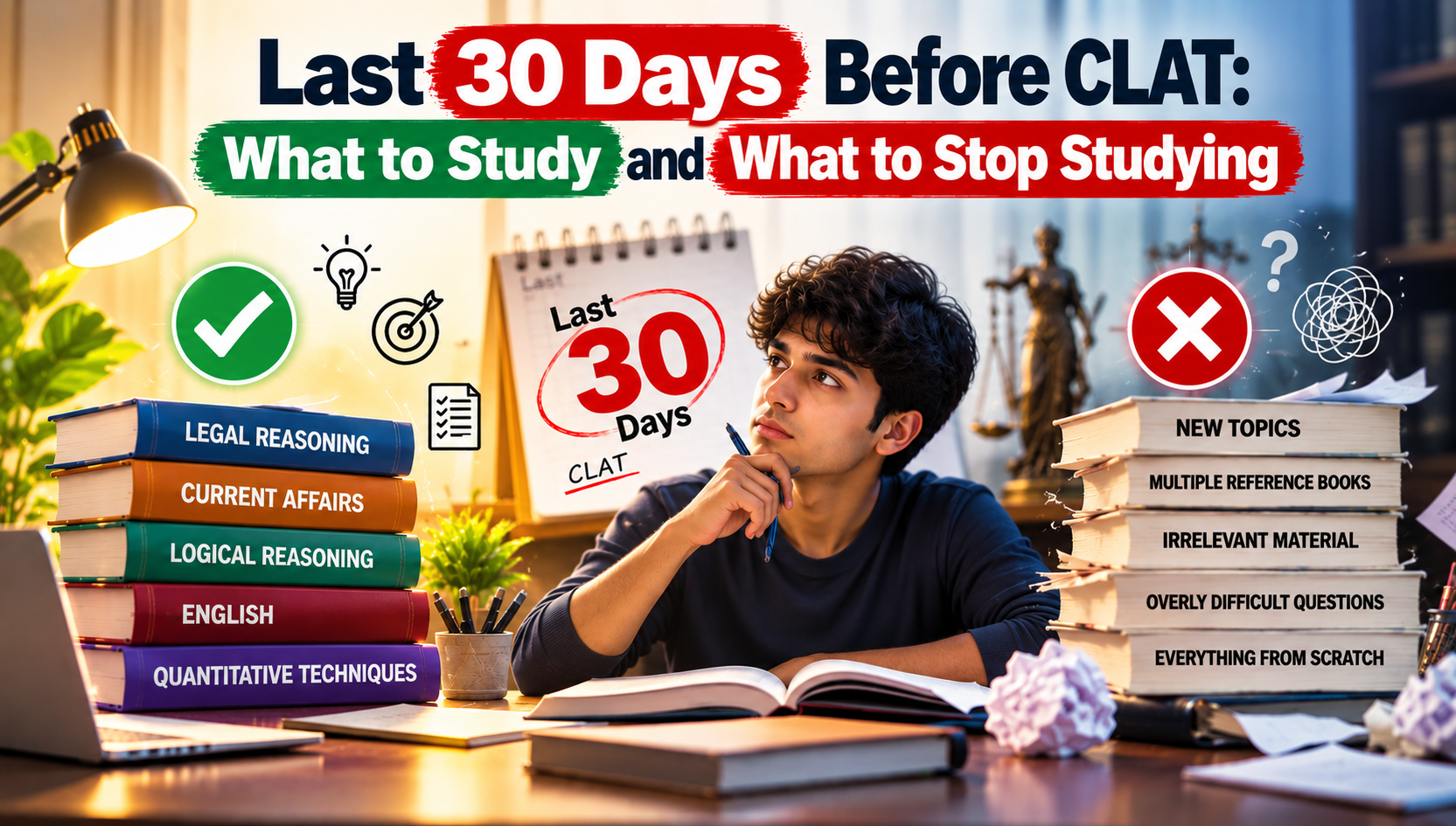
The last 30 days before CLAT are not the time to study everything.
They are the time to study the right things repeatedly, sharpen your speed, identify your recurring mistakes, and make sure that whatever you already know actually converts into marks on the final day.
At Maansarovar Law Centre, we work with CLAT aspirants every year, and one thing becomes very clear during the final phase of preparation: students often lose valuable time because they continue behaving as if they still have six months left.
They keep collecting new material, starting new topics and jumping from one source to another.
With only 30 days remaining, your strategy has to change.
Your focus now should be simple:
Revise. Practise. Analyse. Repeat.
This is what your final 30 days should ideally look like.
Your Daily Schedule for the Last 30 Days
For approximately the next three weeks, your preparation should revolve around three non-negotiable activities:
1. Start Your Day With the Newspaper – 1 Hour
Your day should ideally begin with the newspaper.
Spend around one hour reading it, but do not attempt to read every page or every piece of news.
Focus primarily on:
• National news
• International news
• Important current affairs
• Editorials
• Major headlines
At this stage, newspaper reading is useful for much more than current affairs.
CLAT is a reading-intensive examination. Regular newspaper reading keeps you comfortable with long passages, improves your reading speed and helps you process unfamiliar information quickly.
So even if you believe your current affairs preparation is already complete, do not stop reading the newspaper during the final month.
2. Solve One Full Mock Every Day – 2 Hours
For the next three weeks, you should ideally solve one full-length mock every day.
And solve it exactly like the actual examination.
There should be no interruptions, no checking answers in between, no unnecessary breaks, no casually pausing the timer.
These two hours are not merely practice. They are conditioning your brain for the actual exam.
Daily mocks help students to improve: their reading speed, which section to attempt first, improve their selection, time management, concentration, stamina and decision making under pressure.
Most importantly, regular mocks build confidence.
By the time you enter the actual examination hall, solving a two-hour CLAT paper should feel familiar rather than exhausting.
3. Analyse the Mock Properly
A mock without analysis is only half the exercise.
After taking a short break, sit with the paper again and understand your mistakes.
Ask yourself these questions:
• Which questions did I get wrong?
• Why did I get them wrong?
• Was it a conceptual error?
• Did I misread the passage?
• Did I rush?
• Did I spend too much time on a difficult question?
• Was my guess unnecessary?
• Is there a particular topic where I repeatedly lose marks?
Your mock analysis should tell you exactly what you need to revise next.
Do not simply look at your score and move on.
The purpose of a mock is not merely to tell you where you stand. It is to tell you what you need to fix.
What to Study in the Last 30 Days Before CLAT
Now comes the most important question: what exactly should you revise subject-wise?
1. Quantitative Techniques: Do Not Try to Master the Entire Syllabus Now
If there is one topic you absolutely need to revise in Maths during the final month, it is:
Percentage
Percentage is one of the most important foundational topics for CLAT Quantitative Techniques.
Do not restrict yourself to memorising basic formulas. Revise the fundamentals properly and then solve passage-based questions involving percentages, because that is how the concept is likely to appear in CLAT.
Once Percentage is comfortable, focus on three additional areas:
• Profit and Loss
• Ratio and Proportion
• Average
These four areas should form the core of your Maths revision during the final month. At this stage, it is far better to become reliable in a few important topics than to hurriedly study ten new chapters without gaining command over any of them.
2. Logical Reasoning: Focus on High-Utility Areas
For Reasoning, the final phase should involve revision rather than expansion.
Give particular attention to Analytical Reasoning.
Revise these five areas:
• Puzzles
• Ranking and Arrangement
• Directions and Distance
• Coding-Decoding
• Blood Relations
Apart from analytical reasoning, revise one particularly important area from Critical Reasoning:
Statement and Assumption
The objective is not to suddenly build an entirely new reasoning syllabus.
You should now strengthen the question types you already understand so that recognition becomes faster during the examination.
3. Legal Reasoning: Current Law First, Static Law Through Current Affairs
In Legal Reasoning, your first priority during the final month should be important current legal and polity developments that you have studied throughout the year.
This is not the stage to start collecting completely new legal material. Go back to the important developments you have already covered and revise them properly.
However, this does not mean that static law should be ignored.
The better way to understand CLAT Legal Reasoning is this: Current affairs often provides the context, while static law provides the foundation.
Suppose there has been an important development concerning:
• Fundamental Rights
• A constitutional amendment
• A major Supreme Court judgment
• Criminal law
• An important murder or criminal trial
• Rights of citizens
• Election law
• Constitutional institutions
You should understand not only the event but also the basic legal principles connected with it.
For example, if an important criminal-law incident dominates national discussion, revise the basic legal concepts connected with that incident as well.
Therefore, do not study static law randomly.
Study the static law that is linked to important current legal developments. This makes your preparation far more targeted.
4. Current Affairs and GK: Stop Chasing everything under the sun
The last month of preparation is not a good time to memorise thousands of disconnected one-line facts.
Your focus should shift towards the major events of the year.
Ask yourself:
Which events were nationally or internationally significant enough that a CLAT passage could realistically be framed around them?
Topics of this nature may include major international summits, geopolitical developments, sporting events, important national developments, major legal events or incidents that remained in the news for a considerable period.
For example, important areas this year may include topics such as:
• BRICS Summit
• Major international aviation incidents
• FIFA World Cup-related developments
• Major national or international political events
• Important legal and constitutional developments
Do not merely know one fact about these topics.
Understand:
• What happened?
• Why was it important?
• Who were the major stakeholders?
• What was India’s role, wherever relevant?
• What institutions or organisations were involved?
• What background facts are likely to be tested?
CLAT increasingly rewards contextual knowledge, not just random memorisation.
5. English: Your Entire Preparation Is Already Helping You
English is one section where separate preparation during the final month can actually be reduced.
If you are:
• Reading the newspaper daily
• Solving mocks
• Reading Legal Reasoning passages
• Reading Current Affairs passages
• Analysing comprehension questions
you are already practising English every day.
However, there are certain areas that students should revise separately: Figures of Speech, Theme of Passage, Tone of Passage, Title etc. As these topics are not covered through newspaper reading.
What Should You Stop Studying in the Last 30 Days?
This part is equally important.
Stop Starting Completely New Topics
Unless you have ignored a very basic, high-value topic altogether, the final month should not become a race to complete new books and chapters.
Every new topic has a cost. It consumes time that could have gone into revising something you already know but have not yet mastered.
Stop Collecting New Study Material
You do not need another PDF. You do not need another current-affairs compilation. You do not need another book merely because someone recommended it online. Work with the material you already trust.
The final month should involve consolidation, not collection.
Stop Memorising Random Current-Affairs Facts
Do not spend hours learning isolated appointments, awards, dates and facts simply because they appear in a large GK document.
Prioritise major events and understand them deeply.
Stop Obsessing Over One Bad Mock
Your mock score will fluctuate. One difficult paper does not mean your preparation has collapsed. Look at patterns across several mocks.
If you repeatedly make the same mistake, correct it.
If one mock simply turns out badly, analyse it and move ahead.
What If Something Important Happens During These 30 Days?
There is one important exception to the rule of studying nothing new.
If a major national, international, legal or political event takes place during the final month, you should obviously study it.
CLAT is a current-affairs-oriented examination.
So while you should avoid randomly expanding your syllabus, you should remain alert to important developments occurring close to the examination. Study major new developments.
Ignore insignificant noise.
The Final 30-Day Formula
If your preparation has already been going on for several months, the final month does not require a completely new strategy.
It requires discipline.
For the next three weeks, your day should largely revolve around:
1 hour of newspaper reading + 2 hours of mock testing + detailed mock analysis + targeted revision.
Subject-wise, your revision should remain selective:
• Maths: Percentage, Profit and Loss, Ratio and Proportion, Average
• Reasoning: Puzzles, Ranking and Arrangement, Directions and Distance, Coding-Decoding, Blood Relations, Statement and Assumption
• Legal: Major current law and polity developments plus related static concepts
• Current Affairs: Major events rather than isolated facts
• English: Regular reading and mocks, with separate revision of Figures of Speech
And above everything else:
Do not confuse studying more with preparing better.
During the last 30 days before CLAT, improvement comes from repeatedly doing the things that actually matter.
Read every day.
Solve a mock every day.
Analyse your mistakes.
Revise high-yield areas.
And resist the temptation to suddenly study everything.
The final month is not about expanding your preparation.
It is about converting your preparation into performance.