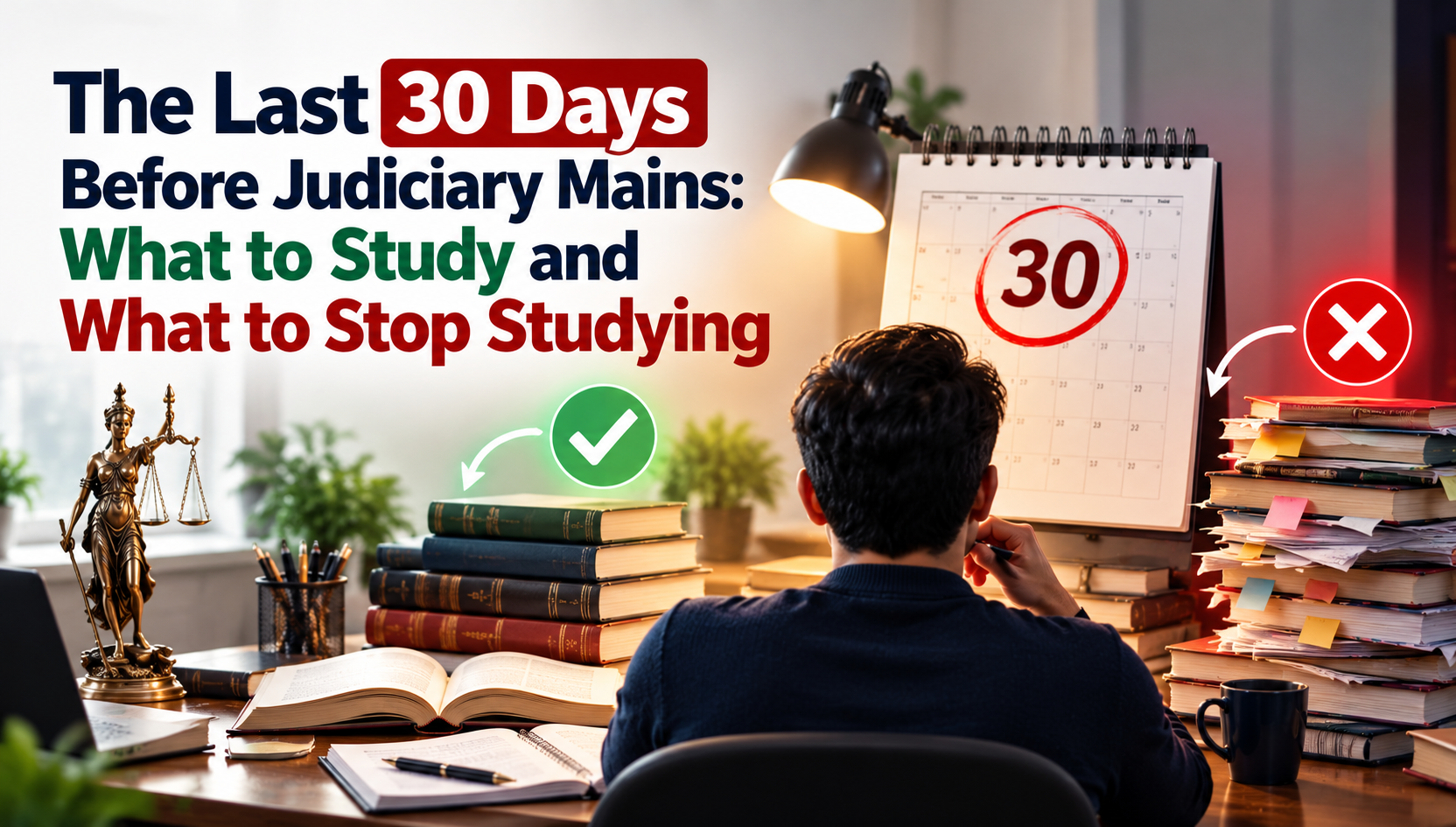
The last 30 days before the Judiciary Mains examination are often the most confusing phase of preparation. An aspirant who has spent months studying Bare Acts, reading commentaries, preparing notes, solving questions and revising important judgments suddenly starts feeling that the preparation is still incomplete.
There is a constant fear of missing something important. One student starts reading a new book because someone recommended it. Another begins making fresh notes on a topic that has already been revised twice. Someone else spends hours collecting judgments, believing that knowing more cases will automatically improve their answers in the examination.
Gradually, preparation becomes less about strengthening what one knows and more about covering whatever still appears unfamiliar.
This is where aspirants need to understand an important distinction: the last 30 days before Judiciary Mains are not meant for restarting preparation. They are meant for making preparation examination-ready.
The objective during this period should be to improve recall, practise answer writing, revise important statutory provisions, identify weak areas and develop the ability to reproduce legal knowledge in a structured manner under time pressure.
So, what should an aspirant study during these 30 days, and what should they consciously stop studying?
1. Revise the Bare Acts Instead of Collecting New Study Material
The first thing an aspirant should focus on during the final month is the revision of Bare Acts. Judiciary Mains is not simply a test of whether a candidate has read a particular subject. It tests whether the candidate can understand a legal problem, identify the applicable provision and apply the law correctly.
For example, while going through the Code of Civil Procedure again, a judicial aspirant should not merely read pleadings chapter. They should be able to recall the relevant provisions, understand the distinction between rejection of a plaint and return of a plaint, explain the principles governing amendment of pleadings and identify the circumstances in which the court may exercise its discretion.
Similarly, while revising criminal law, the focus should be on understanding the ingredients of offences, the relevant exceptions, the applicable punishments and the distinctions between closely related provisions. An aspirant should be able to explain why a particular provision applies to a given factual situation rather than merely recognise its section number.
This is also the time to revisit provisions that are frequently confused with one another. If two provisions have similar language but different legal consequences, the distinction must be clear.
What should an aspirant stop doing? They should stop collecting multiple commentaries, new notes and additional PDFs for subjects they have already studied adequately. Every new source creates another revision burden. Unless a particular topic is genuinely missing from the preparation, the better approach is to return to the material already studied and revise it properly.
2. Stop Reading Judgments Without Understanding Their Relevance
Judgments are an important part of Judiciary Mains preparation, but the final month is not the time to collect hundreds of case names without understanding their legal significance.
Aspirants sometimes prepare long lists of judgments and attempt to memorise the names of the parties, dates, facts, questions of law and final decisions. The problem is that this information may not be retained effectively, and even when it is remembered, the aspirant may not know how to use it in an answer.
Instead, focus on judgments that explain an important legal principle, interpret a statutory provision, clarify a recurring controversy or significantly develop the law.
For every important judgment, try to remember three things: the legal issue, the principle laid down by the court and the relevance of that principle to the subject being studied.
For instance, while revising the constitutional law, a student should understand the legal principle that is discussed in Maneka Gandhi v. Union of India and its significance in the interpretation of Article 21. Merely remembering the case name is not enough. The candidate must understand how the judgment expanded the understanding of the protection of life and personal liberty.
The same approach should be followed for judgments relating to criminal law, evidence, civil procedure and other subjects included in the examination.
What should an aspirant stop doing? Stop trying to memorise every judgment mentioned in a coaching class, compilation or current affairs document. A smaller set of well-understood judgments is generally more useful than a long list of cases that cannot be applied meaningfully.
The purpose of studying judgments is not to decorate an answer with case names. It is to strengthen the legal reasoning behind the answer.
3. Give Answer Writing Priority Over Passive Reading
One of the biggest mistakes aspirants make in the final month is spending almost the entire day reading while postponing answer writing until they feel completely prepared.
The problem is that feeling prepared and being able to write a good answer within the examination's time limit are two different things.
An aspirant may know the law but still struggle to identify the central issue, organise the answer, explain the applicable provision, apply the law to the facts and reach a reasoned conclusion. These are skills that improve through practice.
During the last 30 days, answer writing should become a regular part of preparation. Practise different types of questions, including legal problem questions, questions requiring statutory explanations, questions on important judgments and questions asking for critical analysis of a legal principle.
For example, if a question asks whether a particular order passed by a civil court is appealable, the answer should not begin with a general explanation of appeals under the CPC. Similarly, in a criminal law problem, simply reproducing the definition of an offence will not be sufficient if the question requires the candidate to determine whether the accused is liable. The ingredients of the offence must be applied to the facts.
After writing an answer, examine whether it directly addresses the question, whether the relevant provisions have been correctly identified, whether the reasoning is legally sound and whether the conclusion follows from the analysis.
What should an aspirant stop doing? Stop postponing answer writing until the syllabus is completely revised. There will almost always be another topic to revise.
4. Identify Weak Areas Instead of Revising Every Topic Equally
The final month should not be treated as a period in which every subject and every topic receives exactly the same amount of time.
Aspirants often follow a fixed revision schedule without considering their actual level of preparation. A subject they understand well may receive the same amount of attention as a subject in which they repeatedly make mistakes.
This is not an efficient use of the remaining time.
Instead, a student should divide topics according to their level of preparation. Topics that are well understood and known should require quick revision and recall practice. Topics that are familiar but repeatedly cause confusion or demands attention require focused revision. Suppose an aspirant is quite familiar with the general principles provided under the Indian Partnership Act but is confused in chapters like incoming and out going partners. Spending another three hours reading the entire Act from the beginning may be less useful than revising those specific provisions, understanding their distinctions and solving questions based on them.
Similarly, if an aspirant understands the principles of res judicata but struggles to apply them to factual situations, the solution is not necessarily to read another explanation of the doctrine. The aspirant should practise problem questions that require the application of the principle.
What should an aspirant stop doing? Stop revising familiar topics repeatedly merely because they provide a sense of comfort. Preparation should be guided by the areas that need improvement, not only by the subjects the aspirant enjoys studying.
5. Stop Making Perfect Notes and Start Testing Your Recall
The last 30 days are not the ideal time to rewrite the entire syllabus into beautifully organised notes.
Making notes can be useful during the initial stages of preparation. However, in the final month, excessive note-making can consume time that should be spent on revision, recall and answer writing.
Aspirants should focus on concise revision material containing important statutory provisions, frequently confused concepts, essential distinctions, significant judgments and mistakes identified during practice.
The purpose of such material is to make revision faster and more effective. It should not become another version of the textbook.
More importantly, aspirants should test their recall instead of relying exclusively on repeated reading. After revising a topic, close the book and try to reproduce the important provisions, legal principles or distinctions from memory. Attempt a question without looking at the notes. Then check what was missed or incorrectly recalled.
For example, after revising the principles governing temporary injunctions under the CPC, an aspirant should be able to identify the relevant legal requirements and explain how they operate in a factual situation without having to reopen the material for every point.
This exercise helps reveal the difference between recognising information while reading and actually being able to recall it independently.
What should an aspirant stop doing? Stop spending hours formatting notes, highlighting entire paragraphs and copying material that is already available in a book. The value of revision lies in what the aspirant can remember and use, not in how comprehensive the notes appear.
6. Practise Under Examination Conditions and Protect Your Final Week
The final stage of preparation should gradually move towards examination-oriented practice.
Aspirants need to become comfortable answering questions within a prescribed time limit, allocating time between questions and maintaining the quality of their answers throughout the paper.
Writing one good answer without any time restriction is different from completing an entire paper under examination conditions. The latter requires concentration, speed, judgement and the ability to move forward when a question is difficult.
Practise timed answers and full-length papers wherever appropriate. After each exercise, assess not only the legal content but also the time taken, the clarity of the structure, the relevance of the discussion and the ability to complete the paper.
Sleep, concentration and consistency matter too. Exhausting yourself through unnecessarily long study hours can reduce the quality of revision and make it harder to recall information during the examination.
What should an aspirant stop doing? Stop comparing daily preparation with other aspirants, changing study plans every few days or starting an entirely new source because someone claims it is essential. Other candidates may have different levels of preparation, different strengths and different weaknesses. Your final month should be guided by your own preparation and the requirements of your examination.
Conclusion: The Last 30 Days Are About Staying Calm and Focused
The last 30 days before Judiciary Mains can strongly influence your result. However, this period should not be approached with the fear that the entire syllabus must be studied again.
The priority should be to revise the Bare Acts, understand important judgments, practise answer writing, identify weak areas, test recall and develop the ability to complete papers within the prescribed time.
There will always be another book to read, another judgment to memorise and another set of notes to collect. The challenge is to recognise which activities will genuinely improve your performance and which are simply creating the feeling of being busy.
Aspirants must remember that the objective is not to know everything about every subject. It is to understand the relevant law, apply it correctly and present it clearly when the examination demands it.
At Maansarovar Law Centre, we focus on helping the students to move beyond the completion of the syllabus and develop the concepts of legal reasoning and answer-writing skills required for Mains.
In the last 30 days, do not measure your preparation by how much new material you have collected. Measure it by how much of the law you can recall, explain and apply independently.