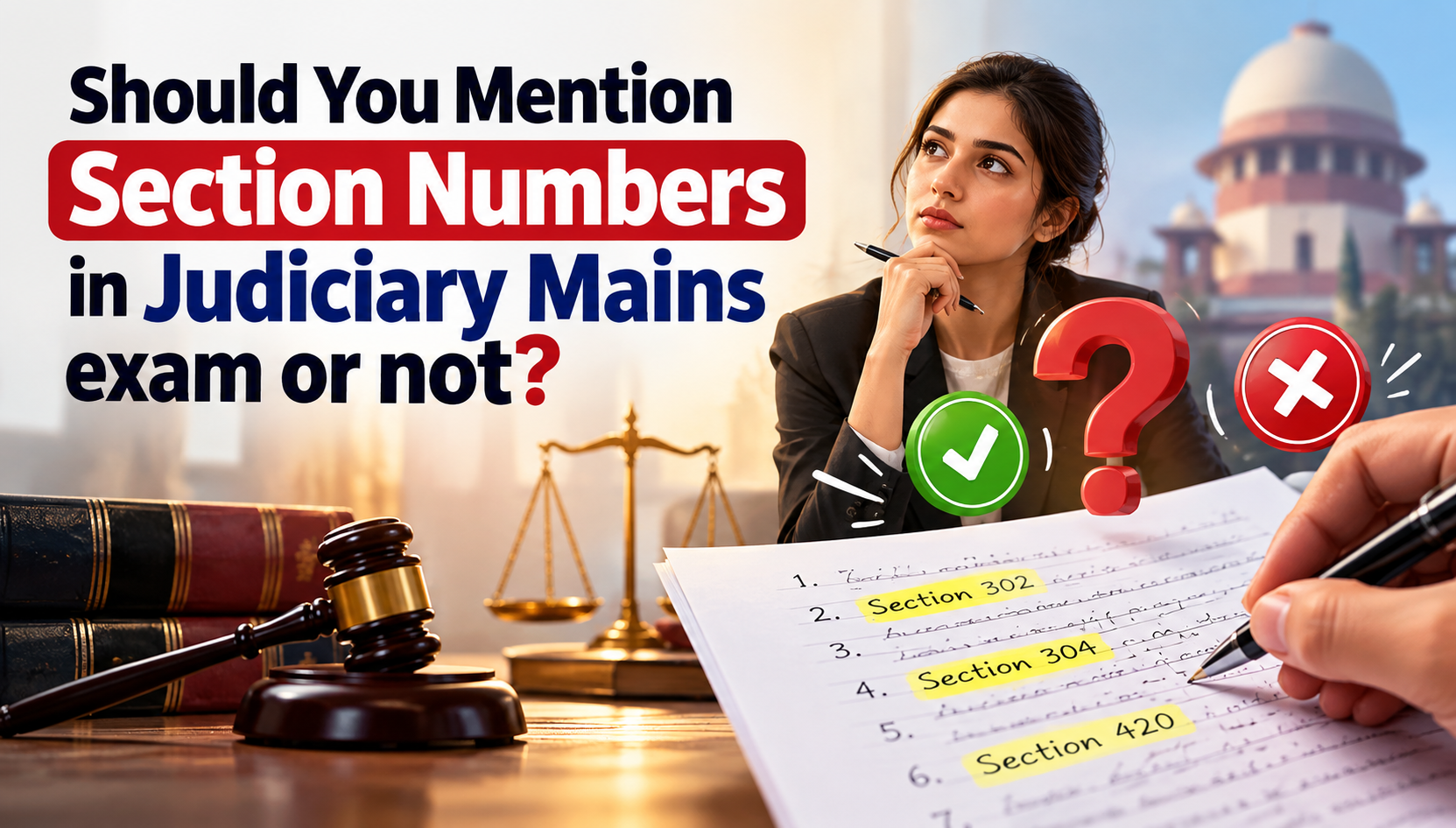
One question that students preparing for Judiciary exams often enquire is: should they mention section numbers in their Mains answers or not.
The answer is not simply yes or no.
It depends on the nature of the question and what exactly the examiner is asking.
When it comes to the Prelims examination section numbers are extremely important. Many questions are direct and a student is expected to remember the important provisions of the relevant laws. If a question asks you which section deals with a particular provision then knowing the exact section number becomes important. This is why while preparing for Prelims students spend a lot of time memorising important sections.
But the approach changes when you reach the Mains examination.
In Mains your answer is not judged only on whether you remember a section number. The examiner is looking at your understanding of the law. The way you explain the legal principle. The way you apply the law to the question. Your use of relevant judgments and the overall structure of your an-swer.
So when should you mention the section number?
There are broadly three situations that you should understand.
First is when the question is specifically about a particular section.
For example the question may ask you to explain a particular provision and discuss its scope or appli-cation.
In such a question the section number becomes extremely important. If the question itself revolves around a particular provision then you should mention the section clearly. You should explain what the provision says and then discuss the relevant legal principles and judgments.
Here avoiding the section number would not be a good strategy because the section itself is the focus of the question.
Second is when the question directly asks you about a legal issue where the relevant section is important.
For example suppose the question asks you about the grounds of divorce under the Hindu Marriage Act and asks you to explain the grounds provided under the Act.
Here mentioning the relevant provision can make your answer much more precise. You can mention the section and then explain the different grounds. You can also support your answer with important judgments.
This shows the examiner that you know both the legal principle and its statutory basis.
Third is when the question is more general.
Suppose the question asks you to discuss the different types of divorce recognised under different per-sonal laws.
Here you do not necessarily need to force a section number into every part of your answer.
You can structure your answer around the different laws. You can explain the relevant principles. You can mention important judgments and then compare the different positions.
Even if you do not mention a particular section in every paragraph your answer can still be a very good answer.
The most important rule is this.
Do not guess section numbers.
This is particularly important when you are confused between two sections.
Suppose you know the legal principle perfectly but you cannot remember whether the relevant provi-sion is Section 6 or Section 8 of the Indian Partnership Act.
Do not write both. Do not write Section 6 and then write Section 8 hoping that one of them will be correct. And most importantly do not write a section number when you know that you are probably wrong.
For example you may know the essentials of partnership and you may know the legal principle relat-ing to whether profit making is necessary. But if you remember the provision and are not sure about its exact section number then it is better to write:
The relevant provision under the Indian Partnership Act provides that...
and then explain the law correctly.
This is much better than mentioning an incorrect section number.
Remember that the examiner already knows that you have cleared the Prelims and have reached the Mains examination. You are expected to know the law. But you are not expected to show your knowledge by writing a section number at every possible opportunity.
In fact a wrong section number can sometimes create a bigger problem.
If you write the wrong section number the examiner may feel that you are not clear about the statutory provision itself. Even though your legal principle may be correct your answer may appear less accu-rate.
So the simple rule for Judiciary Mains is:
If you are sure about the section mention it.
If the question specifically asks about the section definitely mention it.
If you are not sure about the section explain the correct legal principle without guessing.
Never mention two sections because you are confused between them.
Your priority should always be accuracy.
A correct legal principle without a section number is far better than a wrong section number with a correct legal principle.
At Maansarovar Law Centre we help students memorise important sections through simple tech-niques. More importantly we help students understand which sections are important and where they should actually be used in an answer.
We also solve previous year questions so that students understand how statutory provisions are tested in the examination and how they can use their knowledge effectively in their Mains answers.
Because Judiciary Mains is not only about remembering the law.
It is about knowing what to write and when to write it.