PARLIAMENTARY COMMITTEES
A Parliamentary Committee is a committee consisting of Members of Parliament (MPs) who are elected or nominated by either House of Parliament or by the Speaker of the Lok Sabha or the Chairman of the Rajya Sabha. It functions under the authority and direction of the respective Presiding Officer and submits its reports and recommendations to Parliament. It studies and deals with various matters that cannot be directly handled by the Parliament due to their volume and content nature. Parliament makes laws on various subjects. A member of parliament can’t be an expert in all fields.
The concept of Parliamentary Committees has been borrowed from the British Constitution.
Law making is a very cumbersome task and is done by experts in that field e.g., Union Home Minister Amit Shah introduced the Constitution (One Hundred and Thirtieth Amendment) Bill, 2025 in the Lok Sabha to establish a legal framework for the removal of the Prime Minister, Chief Ministers, Union Ministers, State Ministers, and Chief Minister and Ministers of NCT of Delhi, if they are arrested and held in custody for 30 consecutive days on charges punishable with at least five years of imprisonment. This bill has been sent to a select committee for detailed study on this issue.
Parliamentary committees also monitor the functioning of the executive organ of the union government. The executive is the one of the organs of the government that implements law and has the responsibility for the governance of a state.
Need for Parliamentary Committees -
The increasing complexity of governance and the limited time available for parliamentary debates make Parliamentary Committees indispensable. They enable detailed scrutiny of legislative proposals, government expenditure, and administrative performance.
Owing to these functions, Parliamentary Committees are often referred to as the “Mini Parliament” or the “Eyes and Ears of Parliament.”
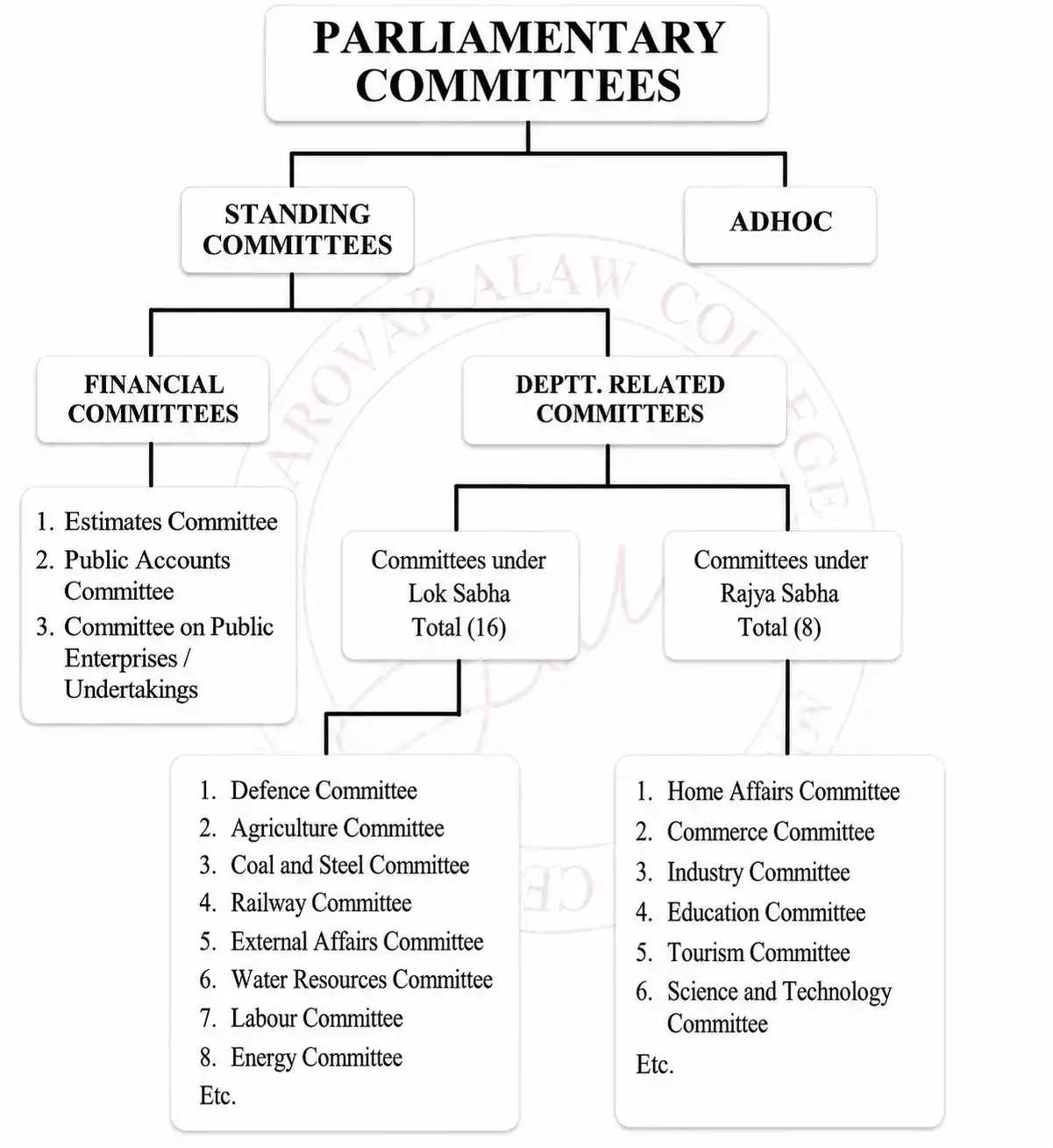
Parliamentary committees can be subdivided under two headings as:
I Standing Committees:
II Adhoc Committees
STANDING COMMITTEES
These committees exist all the time, they are permanent in nature and perform their functions regularly. Standing committees can be subdivided under two headings:
a) Financial Committees
b) Deptt. Related Committees
A. FINANCIAL COMMITTEES:
There are three important Financial Committees of Parliament:
i. Estimate Committee (EC):
The estimate committee has 30 members and all are from Lok Sabha. Members are elected by Lok Sabha and their tenure is 1 year. Its chairperson is appointed by the speaker of Lok Sabha among members. A union minister cannot be a member of this committee. The estimate committee examines whether the money is well laid out within the limits of policy implied in the estimates.
This committee suggests alternative policies for efficiency and economy. Sh. Sanjay Jaiswal- BJP Leader is Chairperson of this committee.
ii. Public Accounts Committee (PAC)
The Public Accounts Committee consists of 22 members (15 from Lok Sabha and 7 from Rajya Sabha). Members are elected by Lok Sabha and Rajya Sabha respectively. Tenure of members is one year. A union minister cannot be a member of this committee. This committee Audits the revenue and expenditure of the government of India.
The Public Accounts Committee examines the audited report of C.A.G. after it is laid in parliament. C.A.G. assists this committee during the course of investigation. As a convention this committee is always headed by the Leader of Opposition. Presently, Congress Leader K C Venugopal is Chairperson of this committee.
iii. Committee On Public Undertakings
This committee has 22 members (15 from Lok Sabha and 7 Rajya Sabha). Members are elected by the Lok Sabha and Rajya Sabha respectively. Tenure is one year. This committee examines the Accounts of Public undertakings and considers the report of C.A.G. on Public undertakings, suggest ways to improve the efficiency and economy in working of public undertakings. A union minister cannot be a member of this committee.
BJP Leader Sh. Baijyant Panda is Chairperson of this committee.
B. DEPARTMENTAL RELATED COMMITTEES:
There are 24 Deptt Related Standing Committees. Each committee consists of 31 members (21 from Lok Sabha and 10 from Rajya Sabha). The tenure of each committee is not more than 1 year. Members from Lok Sabha are nominated by the Speaker of Lok Sabha and members from Rajya Sabha are nominated by Chairperson of Rajya Sabha.
Some Other Standing Committees:
i. Business Advisor Committee
ii. Committee on Privileges
iii. Committee on Empowerment of Women
iv. Committee on Petitions
v. Rules committee etc.
AD-HOC COMMITTEES:
Adhoc Committees are temporary in nature. They are established for a particular purpose and after completion of that purpose, their presence ceases to exist e.g., Balwant Rai Mehta Committee was established in 1957 to review the working of community development programmes and suggest ways for further improvement in the system. This committee submitted its report in 1978 and recommended establishment of Panchayati Raj System in India. After submitting its report this committee ceased to exist. Some of the examples of ad-hoc committees are
i. Balwant Rai Mehta committee, 1957
ii. Ashok Mehta committee, 1978
iii. Sri Krishna committee on Telangana, 2010
iv. Naresh Chandra committee 2012 on Defence
v. Five-year plan draft committee
vi. Hindi equivalent committee
vii. Railway convention committee
viii. Select & joint committee on bills
Powers and Function of Parliamentary Committees -
1. Legislative Examination - These committees examine the Bills in detail and analyse each provision, take expert opinions and recommend amendments before they are passed by the Parliament to improve the quality and effectiveness of legislation.
2. Financial Scrutiny - Financial Committees scrutinise the Union Budget, government expenditure, audit reports, and the functioning of Public Sector Undertakings (PSUs) and ensure that public funds are spent efficiently, economically, and according to the approval of Parliament.
3. Executive Scrutiny - Parliamentary Committees look over the performance, programmes and the policies of Ministers and government departments. They have the power to summon Ministers and government officials to provide explanations, and ensure accountability of the executive to Parliament.
4. Policy Review and Recommendations - Committees evaluate government policies and administrative functioning, identify shortcomings, and submit reports containing recommendations for legislative, administrative, and policy reforms. Although their recommendations are advisory, they often influence government decisions.
5. Public Consultation and Expert Opinion - Committees consult experts, stakeholders, civil society organisations, and the public on important issues. This helps Parliament make informed decisions and improves the quality of law-making and governance.