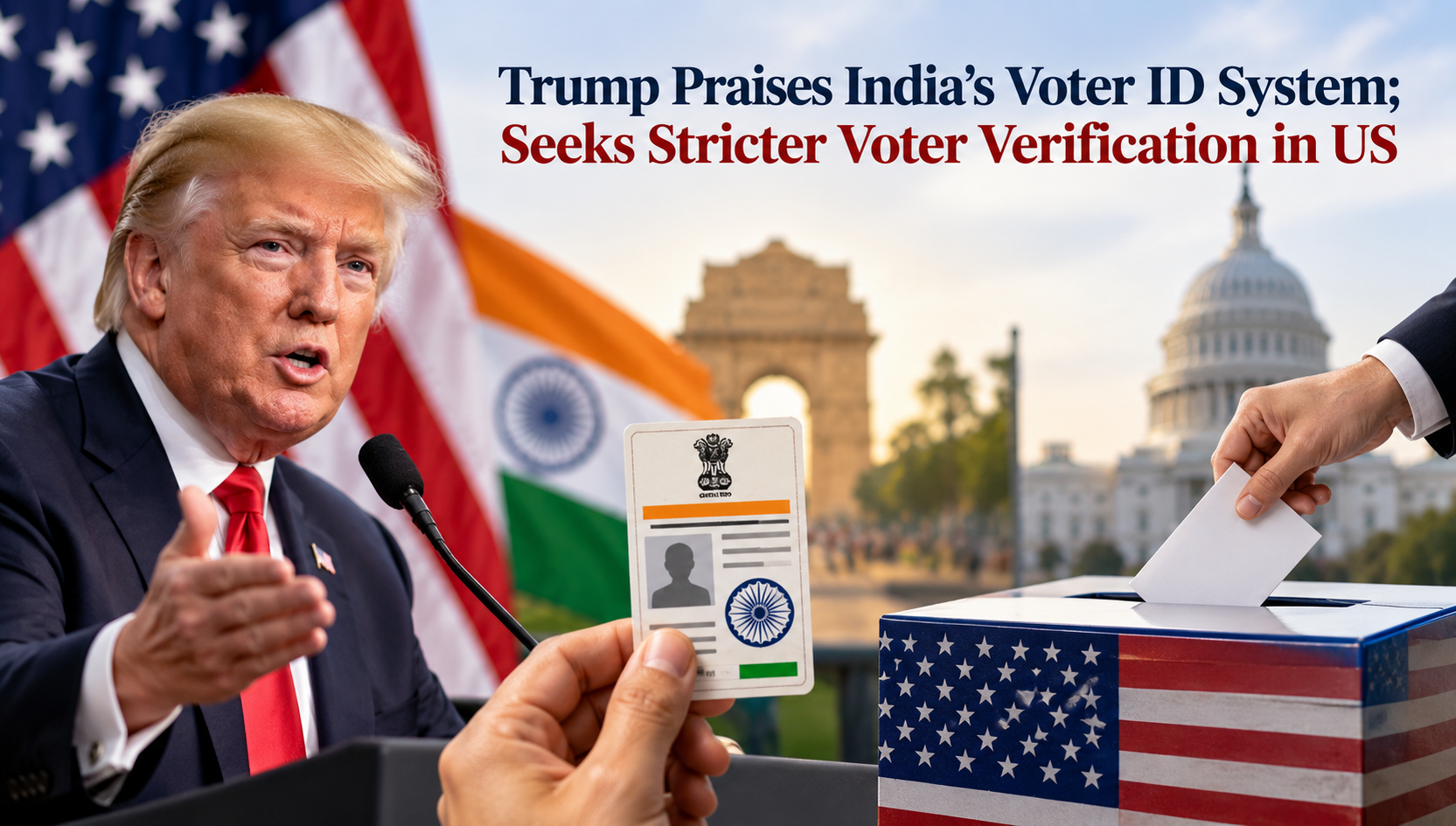
Trump Praises India’s Voter ID System; Seeks Stricter Voter Verification in US
US President Donald Trump praised India’s voter identification system, calling it an example of stronger election security. He highlighted India’s use of photo identification for voting and compared it with the relatively less stringent identification requirements followed in the United States.
Reference to Chief Election Commissioner -
Trump referred to a recent conversation of the U.S. Ambassador Sergio Gor with Chief Election Commissioner Gyanesh Kumar, who reportedly questioned how elections could be conducted in the US without mandatory valid photo identification. Trump used the discussion to strengthen his demand for stricter voter-verification rules in America.
SAVE America Act -
Trump supported the Safeguard American Eligibility (SAVE) Act, which was introduced in the US Congress on January 29, 2026. This law seeks to require documentary proof of US citizenship for federal voter registration, valid government-issued photo ID at polling stations and tighter rules for absentee voting.
India- US Electoral Comparison -
The US administration has compared its electoral system with India and Brazil, pointing to their stronger identity-verification mechanisms. India’s large-scale elections, in which around 642 million people voted in the 2024 general election (Lok Sabha election), were cited as an example of conducting elections with voter identification requirements.
Trump also highlighted that less than 1% of voters used postal ballots in India’s recent general election and emphasised the use of valid photo identification by voters. He presented these features as safeguards against electoral fraud.
Why it is Important -
The development emphasises the growing international discussion around voter identification, citizenship verification and electoral integrity. For India, the remarks also showcase its election-management system as a reference point in debates on strengthening democratic processes.