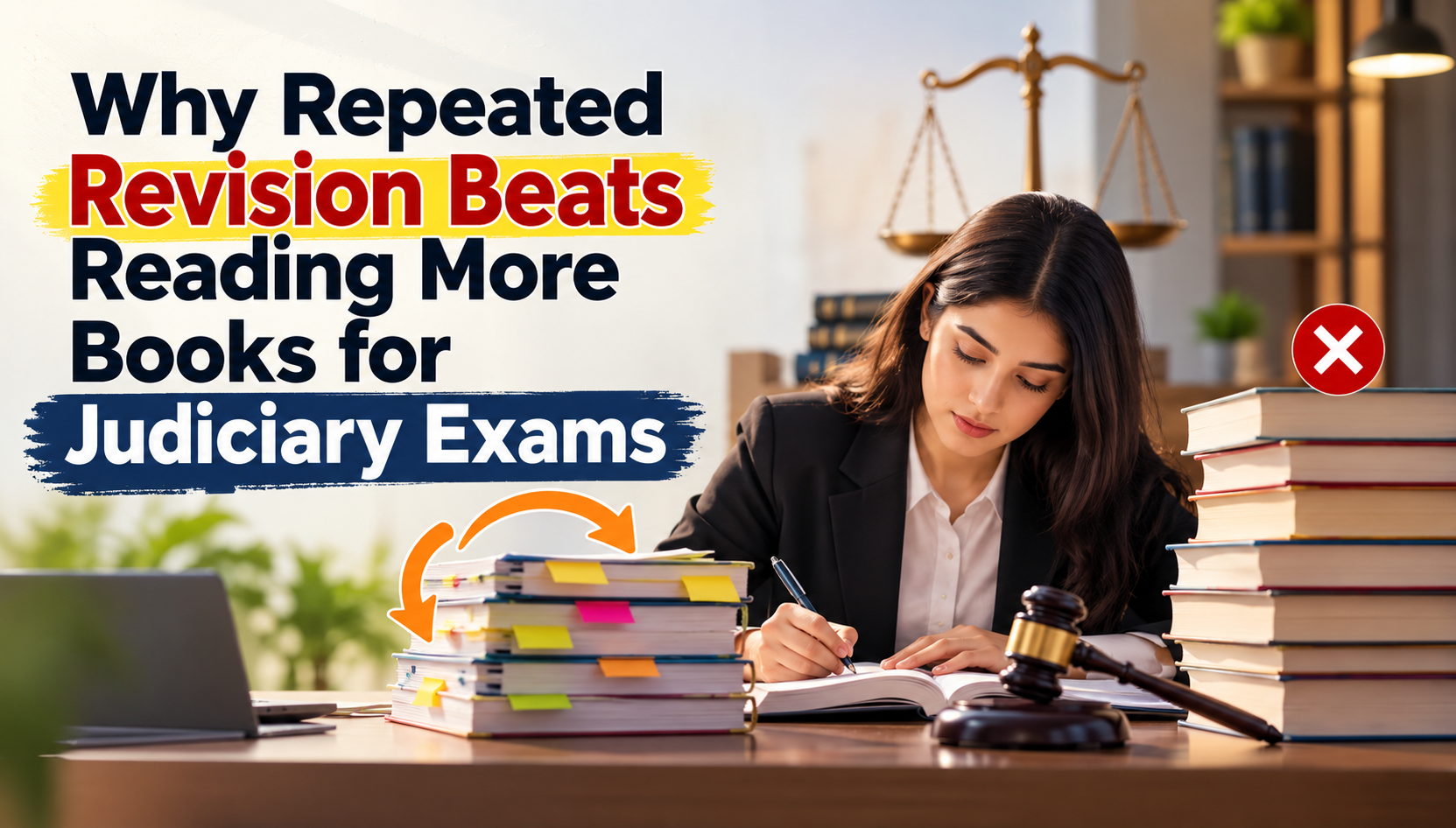
Judiciary preparation can easily turn into a race to collect study material. One book for a subject, another set of notes, a new judgment compilation and then another PDF recommended by someone. And as a result you have plenty of material, but very little time to revise it properly.
For judiciary exams, revising a limited amount of reliable material repeatedly is often more useful than constantly adding new books.
Reading More Does Not Always Mean Remembering More -
When you read something for the first time, it feels familiar. You may even feel that you know the topic well. But after a few weeks, many details start fading.
This is why simply finishing another book does not necessarily improve your preparation. If you cannot recall the important provisions, exceptions and case laws when solving a question, the extra reading has limited value.
Revision brings the information back before it is forgotten and the Bare Act Needs Repeated Revision. For judiciary aspirants, the Bare Act should not be treated as a book that you read once and keep aside.
Important provisions, explanations, provisos and exceptions need to be revisited regularly. The first reading helps you understand the provision. Later revisions make it easier to recall the exact legal position during the examination. With repeated revision, provisions that once required effort to remember start becoming familiar.
Revision Also Helps You Find Your Weak Areas -
The first time you study a subject, you may not know what you have forgotten. Revision exposes those gaps and you may realise that:
• You remember the main provision but forget the exception.
• You know the name of the case but not the principle.
• You understand the concept but often confuse two similar provisions.
• You remember the law but struggle with application based questions.
These are exactly the areas that need more attention as too many books can create confusion. Different books may explain the same concept in different ways. This can be useful at the beginning, but constantly switching sources can make revision difficult.
Instead of asking, “What should I study next?”, ask yourself “Have I revised what I have already studied enough?”
For most subjects, it is better to have a limited and reliable source base that you can revise multiple times. Revision should not mean reading the same pages again rather good revision is active.
After studying a topic, close the book and try to recall:
• The relevant provisions
• Important ingredients
• Exceptions and provisos
• Important case laws
• Key legal principles
Then solve MCQs or attempt a short mains question. This tells you whether you actually remember the topic or only recognise it when it is in front of you.
Make Revision a Regular Part of Your Schedule -
Instead of leaving revision for the final month, divide it throughout your preparation. For example:
First revision - Within a few days of completing the topic
Second revision - After a few weeks
Third revision - During subject-wise revision
Final revision - Before the examination
The exact schedule can differ from person to person. What matters is that revision happens repeatedly instead of being left until the end.
Revision and Practice Should Go Together -
Revision becomes much more useful when followed by questions. After revising a topic, solve previous-year questions or MCQs from the same area. For mains preparation, write an answer without looking at your notes.
This connects memory with application as you may know a provision while reading it, but the real test is whether you can recall and use it without the book in front of you.
Quality of Revision Matters More Than Quantity of Material -
Judiciary preparation is not about finishing the maximum number of books. It is about being able to recall the law when you actually need it.
A student who has revised one reliable source four or five times may have stronger command over the subject than someone who has read four different books only once. So, before adding another book to your study table, ask yourself if I have completely revised the material that I already have and if the answer is no, then revision may be the better use of your time.
Prepare Smart With Maansarovar Law Centre -
At Maansarovar Law Centre, Delhi, our Judiciary courses focus on building strong legal concepts along with regular revision, practice, current affairs, answer writing and mock tests.
The aim is not just to complete the syllabus but to help students retain, revise and apply what they study. If you are preparing for the judiciary and looking for structured guidance, feel free to contact us: 9999799728 | 9999799769
Study less randomly. Revise more consistently. And make what you have studied exam-ready.